The workflow ran fine for weeks, then quietly stopped, and nobody noticed until a client did.
You built an n8n automation that worked in testing. In production it breaks on token expiry, silent errors, and rate limits. We rebuild it to run unattended, tell you the moment something fails, and stay fixed.
Built to fail safely
retries, auth refresh, and error branches on every fragile call
Watched, not assumed
monitoring and alerts on every single run
Owned, not abandoned
ongoing support when platform APIs change



We take your fragile workflow and make it production-grade. Same job, but it recovers from failures, alerts you the moment it cannot, and does not die when an API changes underneath it.
Audit your workflow
Find every silent failure point
Rebuild the logic
Retries, auth refresh, error branches
Add monitoring
Every run watched, not assumed
Wire up alerts
You hear about it first
Ongoing support
We fix it when APIs shift
The Problem
Why a working automation keeps dying in production
An OAuth token expires and the whole workflow stops, but nothing tells you it stopped.
A rate limit or a timeout throws once, the run fails silently, and the data just never arrives.
A platform ships an API change overnight, and a node that worked yesterday now returns an error.
How each version handles a token that expired overnight
Common failure patterns in self-built n8n workflows
What You've Already Tried
Your DIY workflow versus a production-grade rebuild
A DIY workflow assumes the happy path, so one expired token or timeout takes the whole thing down.
When it fails, it fails quietly, and you find out hours or days later from someone else.
A production build expects failure: it retries, refreshes auth, isolates errors, and alerts you when it truly cannot recover.
What happens when a node fails mid-run
The gap is not n8n, it is production engineering
Silent
failures are the ones that cost you most, because you do not see them coming
n8n is powerful enough to run a real business process. The reason self-built workflows break is that they are built for the demo, not for production. No retries, no auth refresh, no monitoring, no alerting. The tool did not fail. The workflow was never hardened for the conditions it actually runs in.
Observed patterns across self-built automation rescues · 2026
What We Build
What we build when we rebuild your workflow

The resilience layer
We rebuild the workflow to expect failure. Every external call gets retries with backoff, timeouts are handled instead of ignored, and OAuth tokens refresh automatically before they expire. Error branches isolate a failing node so the rest of the run still completes instead of collapsing.
The visibility layer
Every execution is monitored. When a run fails, stalls, or returns something unexpected, the system catches it and alerts you through the channel you actually watch. You stop finding out about breakages from customers, because you find out first, with the context to know what broke.
The support layer
Platform APIs change and rate limits shift, so a production automation needs an owner. We build the logic on Claude Opus 4.8 and GPT Codex, keep the workflow documented, and stay on to fix it when something upstream moves. Your automation gets maintained instead of quietly rotting.
What it looks like
Inside the build: the real tools behind n8n Rebuild and Rescue

Automation pipelines run your busywork end to end, monitored and maintained for you.
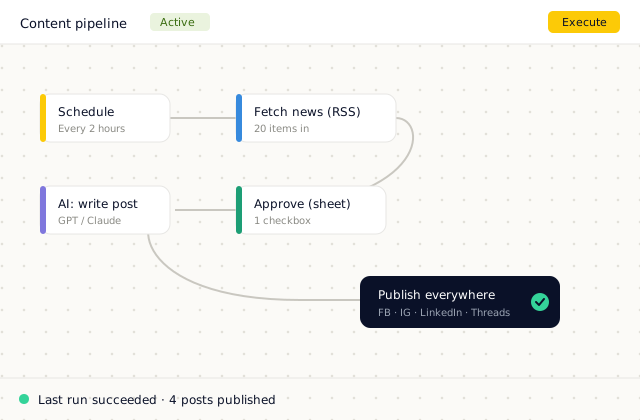
The n8n pipeline that discovers, writes, and publishes, running on schedule.
Results
Why the rebuild holds up where the DIY version did not
Built to fail safely
retries, auth refresh, and error branches on every fragile call
We assume every external service will fail eventually, so the workflow is built to recover from token expiry, rate limits, and timeouts instead of dying on them.
Watched, not assumed
monitoring and alerts on every single run
You never depend on manually checking whether it ran, because monitoring watches every execution and alerts you only when a human is genuinely needed.
Owned, not abandoned
ongoing support when platform APIs change
When a platform changes its API, you have someone who owns the fix, so a breaking change becomes a quick patch instead of a dead pipeline.
FAQ
Questions we get asked.
Silent
failures are the costliest, because you find out last. We make sure you find out first.
Stop losing revenue to
an unanswered phone.
Send us the workflow that keeps breaking. We audit it, tell you whether to harden or rebuild, and turn it into an automation you can trust to run without you watching it.
Or email aditya@tryagentikai.com